
Introduction
Your IT support is about to stop waiting for you to call. That is the single biggest shift happening in business technology right now, and it will change what you pay, how fast your problems get fixed, and what "good IT support" even means for a small or medium business in Calgary.
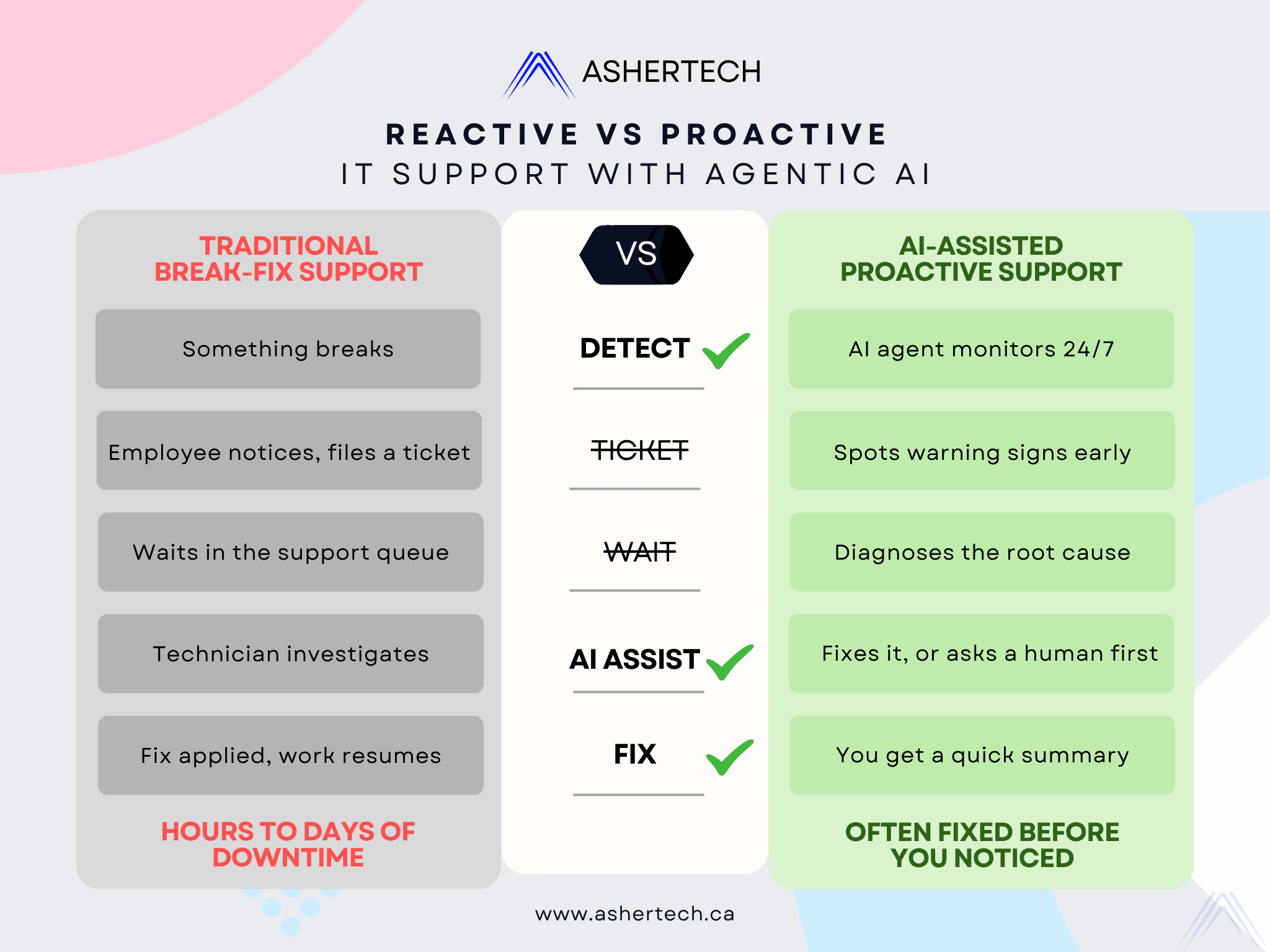
For most of the last two decades, IT support worked like a fire department. Something breaks, you call, someone shows up (or dials in), they put out the fire, and you go back to work. That model is being quietly replaced by something new: software that watches your systems around the clock, spots problems before you notice them, and in a growing number of cases fixes them on its own, with a human signing off on anything risky.
The engine behind this shift is "agentic AI." You have probably heard the term. Most explanations are written for CIOs at Fortune 500 companies. This one is written for the person who owns a 12-person accounting firm in Airdrie, runs three restaurant locations across Calgary, or manages IT part-time for a growing logistics company while also doing four other jobs. Here is what agentic AI actually is, what the research says it will do to IT support over the next few quarters, what to watch for, and how to make sure it works for you instead of against you.
What "Agentic AI" Actually Means (No Jargon)
Let's start with the words, because the marketing has made them mushy.
A regular AI chatbot, the kind you have used on a retail website, answers questions. You type "how do I reset my password," and it tells you the steps. It talks. Then you go do the work.
An AI agent is different. It has a goal, and it can take actions to reach that goal using the tools it has been given. You say "reset my password," and the agent verifies who you are, actually performs the reset in the system, confirms it worked, and closes the ticket. No human involved. It doesn't just tell you the steps. It does the thing.
That's the whole distinction, and it matters more than it sounds. As the security researchers at KDnuggets put it in April 2026: "AI agents do not just answer questions. They act." They plan multi-step tasks, connect to your other software, and carry out work on your behalf.
Think of it as the difference between a manual that explains how to change a tire and a service that notices your tire is low, drives to your car, and changes it while you're in a meeting.
A few plain-language terms you'll see in this space:
- Agentic AI: AI that can plan and act on its own to complete a goal, not just respond to a single prompt.
- AIOps ("AI for IT Operations"): using AI to monitor IT systems, spot problems, and automate fixes.
- Self-healing systems: infrastructure that detects a fault and repairs it automatically, like restarting a frozen service or rerouting traffic around a failing server before anyone notices.
- Ticket triage: sorting and prioritizing support requests. AI now does much of this instantly.
- Human-in-the-loop: a safety design where AI does the work but a person approves anything important before it happens.
One important warning up front. There is a lot of what Gartner calls "agent washing" going on: vendors rebranding old chatbots and basic automation as "AI agents" to ride the hype. Gartner's Senior Director Analyst Anushree Verma noted in June 2025 that "many vendors are contributing to the hype by engaging in 'agent washing,' the rebranding of existing products, such as AI assistants, robotic process automation (RPA) and chatbots, without substantial agentic capabilities." When you evaluate any IT provider or tool, the question to ask is simple: does it actually take action and resolve things, or does it just talk?
If you want a deeper tour of the agent landscape itself, we've mapped it in Every AI Agent Framework, Platform, and Protocol You Need to Know in 2026.
Why This Matters Right Now, Not Someday
Two things make this the right moment to pay attention, not next year.
First, the technology crossed a real threshold. An independent 2025 benchmark by Fini Labs, built on 90 days of testing across 2,000+ queries and 10 industries, found that agentic AI systems that connect to your software and carry out multi-step tasks "deliver 70-85% autonomous resolution with 85-90% accuracy and <2% hallucinations, versus 40-60% for standard RAG assistants and 20-40% for basic chatbots." In plain terms: the newest tools resolve the majority of routine tier-1 issues on their own, and they do it far more reliably than the question-answering bots that came before.
Second, the analysts who advise the world's biggest companies are unusually aligned on the direction. Gartner projects that 40% of enterprise applications will have task-specific AI agents built in by the end of 2026, up from less than 5% in 2025. On the infrastructure side, Gartner predicts that by 2029, 70% of enterprises will use agentic AI in their IT operations, up from under 5% in 2025.
Here's why that trickles down to your business even if you're nowhere near enterprise scale: the tools your IT provider uses, from help desk software to monitoring platforms to patching systems, are all being rebuilt around AI agents right now. You will get these capabilities whether you plan for them or not, bundled into the services you already buy. The businesses that come out ahead are the ones that understand what's changing and choose their partners accordingly.
And Canadian small businesses are moving. According to Statistics Canada, 12.2% of Canadian businesses used AI to produce goods or deliver services in the year leading up to Q2 2025, double the 6.1% a year earlier. The Canadian Federation of Independent Business (CFIB) found that 45% of businesses report using generative AI to complete tasks, rising to 60%+ among firms with 20-49 employees. Adoption climbs steadily with company size, which means your competitors down the street are almost certainly already experimenting.
The Real Numbers: What AI Is Doing to IT Support
Let's get concrete, because "AI will transform everything" is useless to a business owner trying to make a decision. Here is what the credible research actually shows.
Faster resolution, measured in minutes not hours
The headline benefit is speed. Freshworks' 2025 CX Benchmark Report found AI-powered tools drove a 55% reduction in average first response time, with the most advanced setups dropping first response from over six hours to under four minutes. MSPs (managed service providers, the outsourced IT companies) adopting AI report cutting ticket resolution times by 40-70%.
For a real example at a genuinely small-business scale: the speech-AI company AssemblyAI, using the support platform Pylon, raised its AI resolution rate from the "high 20%" to close to 50% of incoming chats, while first response time dropped from 15 minutes to 23 seconds, a 97% improvement. As their Manager of Support Engineering Lee Vaughn put it, "Now Sonny successfully resolves close to 50% of incoming chats. That has made a real difference in freeing up our team to focus on complex customer needs."
Around-the-clock coverage without a night shift
This is the benefit that matters most for small businesses, and it's the one that's hardest to achieve any other way. AI doesn't sleep. That P1 network outage that used to sit in a queue until 9 AM? With AI-driven monitoring and routing, it hits the on-call engineer at 2:01 AM, or gets resolved automatically before anyone wakes up.
For an SMB that can't afford a 24/7 staffed help desk, this effectively rents you one. You get overnight and weekend coverage as a side effect of the software, not as a line item requiring three shifts of employees.
Real cost savings, but understand where they come from
Gartner's most-cited prediction here, from its March 5, 2025 press release, is blunt: "By 2029, agentic AI will autonomously resolve 80% of common customer service issues without human intervention, leading to a 30% reduction in operational costs."
The savings come from a specific place: cheap resolution of routine, repetitive work. Research cited by Fullview in 2025 found self-service channels cost about $1.84 per contact versus $13.50 for a human-assisted contact, roughly a 7x difference. Forrester's widely cited estimate puts the IT labor cost of a single help desk password reset at around $70. Multiply that across every routine request your business generates, and the math gets serious fast.
Fewer, shorter outages, which is where the money really is
Here's the part every business owner should internalize, because downtime is the silent budget killer. According to ITIC's 2024 Hourly Cost of Downtime Survey, "The average cost of a single hour of downtime now exceeds $300,000 for over 90% of mid-size and large enterprises."
Now, that number is for big companies, and you should be skeptical of anyone who quotes it at a 20-person business. It doesn't apply to you. The honest SMB range, per multiple 2025 analyses (CloudSecureTech, Standley Systems, HD Tech), lands between roughly $1,000 and $10,000 per hour once you add up lost revenue, idle-but-paid staff, recovery costs, and reputation damage. The figure commonly attributed to Datto's 2023 State of the Channel Ransomware Report pegs the SMB average around $8,000 per hour. A 15-person firm knocked offline for a morning can easily burn $1,000+ in payroll alone for idle staff.
The key insight from that research: your hourly downtime cost is mostly fixed by your size, but your total cost is driven by how fast you recover. And recovery speed is exactly what AI improves. According to the 2023 Ponemon Institute State of Security Operations study, organizations leveraging AI-driven analytics "reduce their overall Mean Time To Resolution (MTTR) by 37% compared to traditional manual approaches," with AI similarity-matching cutting the time to identify a fix by 45-65%. Organizations adopting AIOps have also reported up to 45% fewer customer-impacting incidents. Cut a typical outage from a full day to an hour, and you've cut that bill by roughly 90% without changing anything about your business except your preparation.
How Your IT Support Is Already Getting Better
You don't need to buy anything new to benefit from most of this. It's being built into the tools modern IT providers already use. Here's what's changing under the hood, in plain terms.
Ticket triage and routing (already mainstream)
When a support request comes in, AI now reads it, figures out what it's actually about, judges how urgent it is, and routes it to the right person or resolves it outright, in seconds, before a human sees it. SysAid's 2025 analysis found automated workflows improve service-level-agreement compliance by 35% on average and, citing Gartner, that AI-driven ITSM tools can cut incident resolution times by up to 30% just by eliminating the delay between a ticket arriving and being properly assigned.
Autonomous resolution of routine requests
Password resets, software installs, access requests, VPN troubleshooting: the boring, high-volume stuff that eats a help desk alive is increasingly handled end-to-end by AI, including the identity checks and approvals. Aisera reports resolving up to 84% of common inquiries end-to-end. The 2026 guides describe production deployments hitting 67-89% autonomous resolution on automatable categories. Crucially, these run inside tools your team already uses, like Microsoft Teams and Slack, so employees get help without filing a formal ticket at all.
Self-healing monitoring and remediation
This is the shift from reactive to proactive, and it's the biggest deal for reducing downtime. Instead of alerting a human that a server is struggling, modern systems detect the anomaly, diagnose the likely cause, and run a pre-approved fix: restart the service, reroute the traffic, roll back the bad update, expand the capacity. Forrester predicts that in 2026, an agentic AI workflow will prevent a major outage autonomously. One network AIOps demonstration at Mobile World Congress 2025 (DriveNets) cut incident resolution time by 87% by correlating alerts to a root cause that would have taken human engineers hours to find.
Automated patch management
Unpatched software is one of the leading causes of both breaches and downtime. Syncro's 2026 analysis noted unpatched software accounted for 32% of ransomware attacks and 20% of data breaches in the most recent full-year data. AI-driven patching now scans every device, prioritizes updates by risk, deploys them during off-hours, and, this is the clever part, uses "patch stability scoring" to flag updates likely to break something before they're installed, backing up systems first so a bad patch can be instantly rolled back. Acronis reports one use case where AI cut patching time from four hours to ten minutes.
Self-writing knowledge bases
Every time a problem gets solved, AI can turn that resolution into a documented help article automatically, building a self-service library that deflects the next identical request. Research cited by Supportbench found AI workflows save 73% of the time and reduce costs by 77% when producing knowledge articles, and well-implemented AI knowledge bases deflect 30-50% of repetitive tickets. Your institutional knowledge stops walking out the door when an employee leaves.
Here's a summary of the shift:
| IT Support Task | The Old Way | The AI-Powered Way |
|---|---|---|
| A problem occurs | You notice it, then call for help | System detects and often fixes it before you notice |
| Password reset | Ticket, queue, wait for a technician | Resolved automatically in seconds, 24/7 |
| Sorting requests | A person reads and assigns each ticket | AI classifies, prioritizes, and routes instantly |
| Server issue at 2 AM | Sits in a queue until morning | Auto-remediated or escalated immediately |
| Software patching | Manual, often late or skipped | Automated, risk-scored, with instant rollback |
| Documentation | Written manually, if ever | Generated automatically from solved tickets |
| Coverage | Business hours (or expensive shifts) | Around the clock by default |
What to Watch For in the Coming Quarters
This is where you should focus your attention as a decision-maker. Here are the near-term trends that will affect your bills, your risk, and your choices.
1. Agentic AI moving into everyday help desks
The help desk and IT management platforms are consolidating around AI agents fast. The biggest example: ServiceNow's $2.85 billion acquisition of Moveworks closed December 15, 2025, and in April 2026 ServiceNow reorganized its pricing into three tiers with the fully autonomous "AI agent specialists" reserved for the top tier. Automation Anywhere acquired the AI service desk vendor Aisera in November 2025. Translation for you: the market is reshuffling, and the most capable AI features are increasingly gated behind premium plans. Expect your existing vendors to keep pushing AI-inclusive upgrades.
2. Pricing models are changing. Watch your renewals
This one has direct budget impact. For 25 years, business software was priced "per seat," a flat fee per user. AI agents break that model, because one agent does the work of many people and doesn't log in like a person. Vendors are shifting toward usage-based pricing (pay per action) and outcome-based pricing (pay only when a result is delivered). Intercom, for example, charges $0.99 only when its AI fully resolves a support conversation. Per Deloitte's TMT Predictions 2026, Gartner projects that by 2030, at least 40% of enterprise software spend will shift toward usage-, agent-, or outcome-based pricing, with seat-based vendor revenue share declining from 21% to 15%.
The immediate risk to watch: the "AI tax." According to Tropic's December 2025 data reported by CFO Dive, "AI software prices have risen between 20% to 37%, regardless of vendor category… representing what the company has termed the 'AI tax.'" Tropic COO Justin Etkin notes buyers often learn of the uplift only "maybe 90 days before their renewal." And it catches people off guard: Zylo's 2026 SaaS Management Index, a survey of 218 IT leaders, found 78% experienced "unexpected charges tied to AI or consumption in the past year" (and 60% lacked full visibility into their generative AI usage). Read your renewals carefully over the next several quarters, and ask for predictable, hybrid pricing, a fixed base plus a usage allowance, so you don't get surprise bills.
3. Security: the new risk you must not ignore
This is the flip side of the coin, and it's serious. When you give an AI agent the power to act, to access your systems, change settings, and send emails, you create a new kind of security exposure. A 2026 Dark Reading poll found that 48% of cybersecurity professionals rank agentic AI as the single top attack vector for the year, ahead of deepfakes and everything else. Darktrace's State of AI Cybersecurity 2026 report found 92% of security professionals are concerned about the impact of AI agents.
Two specific threats every SMB owner should know by name:
- Shadow AI: employees quietly using unapproved AI tools that touch company data. IBM's 2025 research (widely cited in 2026) found breaches involving shadow AI cost about $670,000 more than average and take longer to contain. Cisco's 2026 report found most organizations have already given AI systems authority to access databases and trigger workflows, but only 29% felt prepared to secure them.
- Prompt injection: attackers hiding malicious instructions inside content an agent reads (a support ticket, a document), tricking it into taking harmful actions. The scale of the exposure is stark. An arXiv 2026 study (reported by CSO Online and Straiker) found that 94.4% of the AI agents tested in a 2025 benchmark were vulnerable to being hijacked through the content they were asked to read, and OWASP ranks prompt injection as the #1 risk for LLM applications. There is no clean fix yet, so the defense is containment: least-privilege access, human approval for risky actions, and logging every agent action.
The takeaway isn't "avoid AI." It's "insist on governance." Any provider deploying AI agents in your environment should be able to explain their guardrails in plain English.
4. The reality check: not all of this will work
Be skeptical of anyone promising a fully autonomous, hands-off IT department tomorrow. The same analysts bullish on AI are also warning about a correction. Gartner predicts over 40% of agentic AI projects will be canceled by the end of 2027 due to escalating costs, unclear value, or inadequate risk controls. Forrester expects fewer than 15% of organizations to actually enable agentic features in their automation platforms in 2026, because testing and governance are genuinely hard, and describes 2026 as the year AI moves "from hype to hard hat work," from flashy demos to boring, reliable, measurable value.
What this means for you: the winners will start small, target real problems, keep humans in control of anything risky, and measure results. The losers will buy the hype, hand over the keys, and get burned. Pick a partner who talks like the former.
The Concrete Value for Your Business
Strip away the jargon, and here's what a well-run, AI-powered IT setup delivers for a Calgary SMB:
- You stop paying for problems you didn't need to have. Proactive monitoring and self-healing catch issues before they become outages. Given that even a modest outage costs an SMB thousands per hour, preventing a handful of them a year pays for a lot of IT support.
- You get enterprise-grade coverage at small-business prices. Around-the-clock monitoring and instant resolution of routine issues, capabilities that used to require a large internal team, now come bundled into managed services.
- Your people stop wasting time. Recurring small issues (slow logins, password resets, printer problems) that quietly waste 10-15 minutes per person per day get resolved instantly or eliminated. Across a full team over a year, that's hundreds of recovered hours.
- Faster fixes when things do break. Resolution-time reductions of 40-70% mean when something does go wrong, you're back up in a fraction of the time.
- Your IT gets proactive instead of reactive. The whole model flips from "wait for it to break, then pay someone to fix it" to "prevent it from breaking in the first place."
A practical note on jobs, because owners always ask: the evidence so far points to augmentation, not mass replacement. Per Statistics Canada's analysis for Q2 2025, "a vast majority (89.4%) reported no change in their employment levels" after adopting AI, "while 6.3% reported a decrease and 4.3% reported an increase." The pattern in IT is that AI handles the repetitive tier-1 grunt work so your people (or your provider's people) focus on the complex, judgment-heavy problems that actually need a human. We dug into that dynamic in AI Agents Are Your Next Workforce.
What You Can Do Right Now (Even Without Hiring Anyone)
Here's a practical checklist a business owner can act on this quarter, regardless of who provides your IT:
-
Calculate your real downtime cost. Take your annual revenue, divide by your operating hours, add the hourly payroll of everyone who'd sit idle during an outage. That single number tells you how much prevention is worth. Most owners have never done this, and six in ten businesses, per ITIC, can't calculate it at all.
-
Do a five-minute "shadow AI" check. Ask your team what AI tools they're actually using for work. You'll likely be surprised. You can't govern what you don't know exists.
-
Ask your current IT provider three questions: Do you use AI to monitor our systems proactively? Can you resolve routine issues automatically, around the clock? What guardrails keep AI from doing something harmful in our environment? Their answers will tell you whether they're a modern partner or a break-fix relic.
-
Turn on the AI you're already paying for. If you use Microsoft 365, Google Workspace, or a modern help desk tool, you likely already have AI features sitting unused. Microsoft's own case studies show real time savings: one 50-person company, Newman's Own, saved 70 hours per month with Copilot on a single task. For more ideas, see our guide to 10 practical AI use cases for small businesses.
-
Insist on human approval gates. Whatever you automate, make sure a person signs off on anything risky: deleting data, changing security settings, spending money. This is the "human-in-the-loop" principle, and it's non-negotiable.
-
Start small and measure. Pick your single biggest IT time-sink, apply AI to just that, give it 30 days, and measure the result before expanding. This is exactly how the businesses that succeed with AI do it.
Frequently Asked Questions
What is agentic AI, in one sentence? Agentic AI is software that can plan and take real actions to complete a goal, like resetting a password or restarting a failed service, instead of just answering questions about how to do it.
How much does IT downtime actually cost a small business? Credible 2025 analyses put the SMB range at roughly $1,000 to $10,000 per hour once you count lost revenue, idle staff, recovery costs, and reputation damage. Your exact number depends on your revenue and payroll, which is why calculating it for your own business is step one.
Is AI-powered IT support safe? It can be, with governance. The non-negotiables are least-privilege access (agents can only touch what they need), human approval for risky actions, and logging of everything the AI does. A provider who can't explain those guardrails in plain English isn't ready to run agents in your environment.
How Asher Technologies Helps Calgary Businesses
At Asher Technologies, we're a Calgary-based technology company built for exactly this moment: an AI-first partner that treats modern, agentic tools as core to how IT support should work, not as a bolt-on gimmick.
Our IT support and managed IT services for Calgary businesses pair a responsive help desk with proactive, AI-powered monitoring. Behind the scenes, we monitor, patch, and secure every device on your network so problems get caught, and often fixed, before they interrupt your day. We serve Calgary and the surrounding communities, including Airdrie, Okotoks, Cochrane, Chestermere, and High River, with both remote and on-site support. Our approach is built on the numbers that matter: fast response times, high resolution rates, and the kind of uptime that keeps your business running.
Because we're also an AI solutions and software development company, we do more than run modern tools. We understand how they work under the hood. That means we can help you adopt AI-powered IT workflows safely: with the human approval gates, least-privilege access, and governance that keep autonomous systems from becoming a liability. We can automate the routine tasks that drain your team, set up proactive monitoring and self-healing where it makes sense, and keep a human expert accountable for everything that matters. And when you're ready to go further, with custom automations, cloud deployment, networking, or AI integration across your operations, the same local team handles it.
You don't need to become an AI expert. You need a local partner who already is, who will start small, prove the value, and keep you in control.
Ready to see what modern, AI-powered IT support looks like for your business? Contact Asher Technologies for a free, no-pressure consultation. We'll assess your current setup, calculate where downtime and busywork are costing you, and show you exactly where AI can help, and where it can't. Let's make your IT something that just works.